


Guide to Buy Honeycomb Core Material Design for EMI Shielding
Engineering high-performance ventilation systems requires a delicate balance between maximizing airflow and maintaining strict electromagnetic interference (EMI) containment. For data centers, marine vessels, and aerospace facilities, the integration of specialized metal honeycomb structures is the industry standard for achieving this equilibrium. These precision-engineered cores function as waveguide-beyond-cutoff filters, preventing RF leakage while allowing necessary cooling air to pass through unobstructed.
Selecting the right honeycomb core material design involves evaluating cell size, foil thickness, and metallurgical properties to meet specific shielding effectiveness (SE) targets. Whether you are dealing with SUS304 for general corrosion resistance or Hastelloy X for extreme thermal environments, the structural integrity of the brazed joints determines the overall reliability of the shield. This guide explores the technical nuances of customizable metallic honeycomb panels and how to align material specifications with operational requirements.

Technical Architecture of EMI/RF Shielded Honeycomb Ventilation Panels
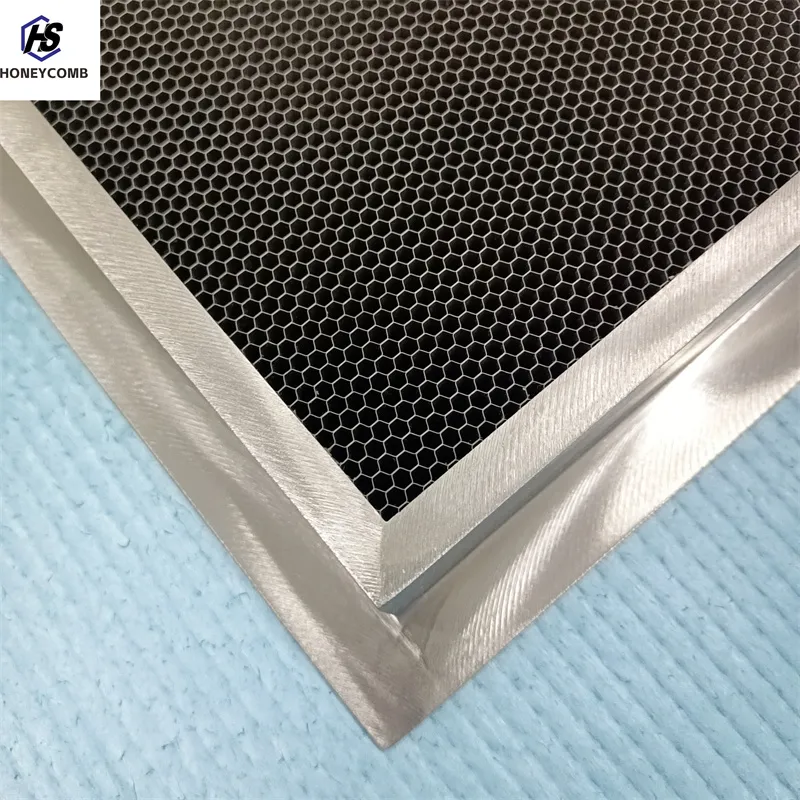
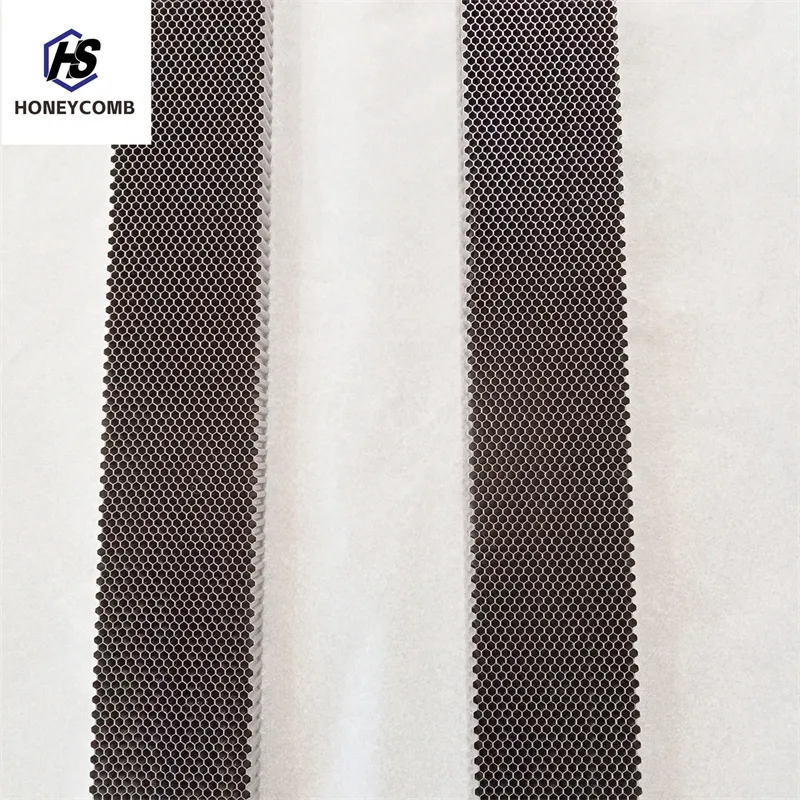
The efficiency of an EMI shielded honeycomb vent is rooted in its hexagonal geometry, which acts as a series of small waveguides. When the cell size is significantly smaller than the wavelength of the interference being blocked, the honeycomb core prevents the propagation of electromagnetic waves. This makes them indispensable for shielded cabinets, racks, and enclosures where electronic components generate high-frequency noise that must be contained to prevent information leakage or system malfunctions.
Advanced manufacturing processes are critical to maintaining this performance. High-temperature vacuum brazing is utilized to ensure that every cell wall is fused securely, eliminating gaps that could lead to RF leakage. Unlike simple spot welding, vacuum brazing provides a seamless, high-strength bond across the entire core, ensuring that the structural stability is maintained even under mechanical stress or thermal cycling. This level of precision is what allows the panels to maintain consistent shielding effectiveness across a wide range of frequencies.
- Waveguide Effect: Utilizing the "cutoff frequency" principle to block RF signals.
- Customizable Cell Sizes: Ranging from 0.8mm for high-frequency blocking to 30mm for high-airflow needs.
- Material Versatility: Available in Aluminum, Carbon Steel, and various Stainless Steel grades.

Material Selection and Surface Treatment for Harsh Environments
The choice of base material directly impacts the longevity and conductivity of the honeycomb core. For most industrial applications, SUS304 and 316L stainless steel are preferred due to their excellent balance of mechanical strength and corrosion resistance. In specialized chemical or high-heat environments, materials like Hastelloy X or brass are deployed to prevent oxidation and maintain structural integrity. The foil thickness—typically ranging from 0.13mm to 0.2mm—is calibrated to balance weight with the required rigidity of the cell walls.
Beyond the base metal, surface coatings play a vital role in both electrical conductivity and environmental protection. Electroless nickel plating is frequently used to enhance the EMI shielding performance and provide a smooth surface for bonding. For applications requiring extreme corrosion resistance or specific aesthetic standards, powder coating, white oxidation, or tin plating may be applied. These treatments ensure that the ventilation panels can withstand salt spray in marine environments or humidity in industrial data centers without degrading.
Industrial Application Scenarios and Integration Requirements
The deployment of honeycomb cores varies significantly across different industries, each presenting unique challenges. In Data Centers, the primary goal is to allow massive volumes of air to cool servers while ensuring that electromagnetic noise does not interfere with adjacent hardware. Here, "L" or "C" type frames are often used to integrate the honeycomb core seamlessly into rack doors or chassis panels, coupled with customized EMI gaskets to ensure a tight seal at the interface.
In Marine and Vehicle applications, the focus shifts toward vibration resistance and corrosion protection. Shielded closures must withstand constant motion and exposure to saline air. Consequently, the use of 316L stainless steel combined with specialized electrophoresis coating is common. Furthermore, in aerospace testing, honeycomb air flow straighteners are used to eliminate turbulence in wind tunnels, demonstrating the versatility of the hexagonal core beyond just EMI shielding.
- Shielded Chambers: Used in EMC testing facilities to isolate the environment.
- EMI Shielded Cabinets: Essential for military and telecommunications equipment.
- Wind Tunnel Modules: Utilizing honeycomb for airflow laminarization and stabilization.
Comparison of Honeycomb Core Material Specifications
| Material Grade | Typical Cell Size | Recommended Coating | Primary Application |
|---|---|---|---|
| SUS304 / 316L | 1.6mm - 6.4mm | Electroless Nickel | EMI Shielded Cabinets |
| Aluminum | 3.2mm - 12mm | White Oxidation | Aerospace / Lightweight Racks |
| Carbon Steel | 4.8mm - 10mm | Powder Coating | Industrial Vent Panels |
| Hastelloy X | Custom | None / Passivated | High-Temperature Exhaust |
| Brass | 0.8mm - 4.2mm | Tin Plating | Precision RF Components |
Engineering Considerations for Custom Honeycomb Design
When specifying a honeycomb core for a new project, engineers must first determine the maximum allowable frequency that can pass through the vent. The relationship between the cell size and the cutoff frequency is the most critical design parameter. A smaller cell size provides better shielding effectiveness but increases airflow resistance (pressure drop). Therefore, a trade-off analysis is required to ensure that the cooling system can still operate efficiently while meeting the EMI/EMC requirements of the facility.
The frame type also influences the installation process. "H" type frames provide maximum structural support for larger panels, while "L" types are ideal for thin-wall insertions. Additionally, the integration of EMI gaskets is mandatory; without a conductive seal between the honeycomb frame and the enclosure, the shielding effectiveness is compromised, as RF energy will leak through the gaps rather than through the honeycomb cells. Proper alignment and compression of these gaskets are essential for "zero-defect" performance.
Future Trends in Metal Honeycomb Manufacturing
The industry is moving toward more complex, multi-layered shielding solutions and the use of exotic alloys to meet the demands of next-generation 5G and 6G infrastructure. As frequencies increase, the requirement for even smaller, more precise cell sizes grows. This is driving the adoption of advanced laser welding and improved vacuum brazing technologies to ensure that the microscopic junctions of the honeycomb are perfectly fused without any residual contaminants.
Moreover, there is a growing emphasis on sustainable manufacturing and ROHS compliance. The shift toward eco-friendly surface treatments, such as advanced electrophoresis and non-toxic powder coatings, ensures that high-performance shielding does not come at an environmental cost. For procurement managers, the focus is shifting from simple cost-per-unit to total lifecycle value, prioritizing suppliers who can offer integrated design, manufacturing, and installation services to reduce system-level failures.
Frequently Asked Questions About Metal Honeycomb Cores
What is the difference between spot welding and vacuum brazing for honeycomb cores?
Spot welding creates individual bonds at specific points, which can leave small gaps and potentially reduce shielding effectiveness. Vacuum brazing, however, involves heating the entire assembly in a vacuum furnace, allowing a filler metal to flow and create a seamless, high-strength bond across all joints, significantly improving RF containment and structural durability.
How do I choose the correct cell size for my EMI vent?
The cell size depends on the frequency you need to block. Smaller cells (e.g., 0.8mm to 2.0mm) provide higher shielding effectiveness for higher frequencies but restrict airflow. Larger cells (e.g., 10mm to 30mm) allow more air to pass through but block only lower frequencies. You must balance your thermal cooling requirements with your EMI shielding targets.
Can you provide honeycomb cores in materials other than stainless steel?
Yes, depending on the application, we can produce honeycomb cores in aluminum for lightweight needs, carbon steel for cost-effectiveness, and specialty alloys like Hastelloy X or brass for extreme temperature or specific electrical conductivity requirements.
What surface coatings are recommended for marine environments?
For marine applications, we recommend using SUS316L stainless steel combined with electrophoresis or powder coating. These treatments provide a robust barrier against salt spray and moisture, preventing corrosion while maintaining the structural integrity of the honeycomb cells.
What are the available frame types for these ventilation panels?
We offer customizable frame types including "L" type, "C" type, and "H" type. The choice depends on how the panel will be mounted into the shielded closure and the amount of structural support required for the specific dimensions of the core.
Are your products compliant with environmental standards?
Yes, our manufacturing processes and materials are compliant with ROHS and SGS certifications, ensuring that the products are free from hazardous substances and safe for use in global markets.
Technical References and Industry Standards
- IEEE Standards for Electromagnetic Compatibility
- ASTM International - Metal Material Specifications
- ISO 9001:2015 Quality Management Systems
- NIST Guidelines for RF Shielding and Measurement
When you need to buy honeycomb core material design for critical infrastructure, partnering with a manufacturer that controls the entire process—from stamping and welding to vacuum brazing and CNC finishing—is essential for ensuring zero-defect performance.
Related Technical Solutions








 English
 Afrikaans
 Albanian
 Amharic
 Arabic
 Armenian
 Azerbaijani
 Basque
 Belarusian
 Bengali
 Bosnian
 Bulgarian
 Catalan
 Cebuano
 China
 China (Taiwan)
 Corsican
 Croatian
 Czech
 Danish
 Dutch
 Esperanto
 Estonian
 Finnish
 French
 Frisian
 Galician
 Georgian
 German
 Greek
 Gujarati
 Haitian Creole
 Hausa
 Hawaiian
 Hebrew
 Hindi
 Miao
 Indonesian
 Italian
 Japanese
 Javanese
 Malay
 Persian
 Portuguese
 Punjabi
 Russian
 Spanish
 Swahili
 Telugu
 Vietnamese